

How Soon Should I Take Emergency Contraception?
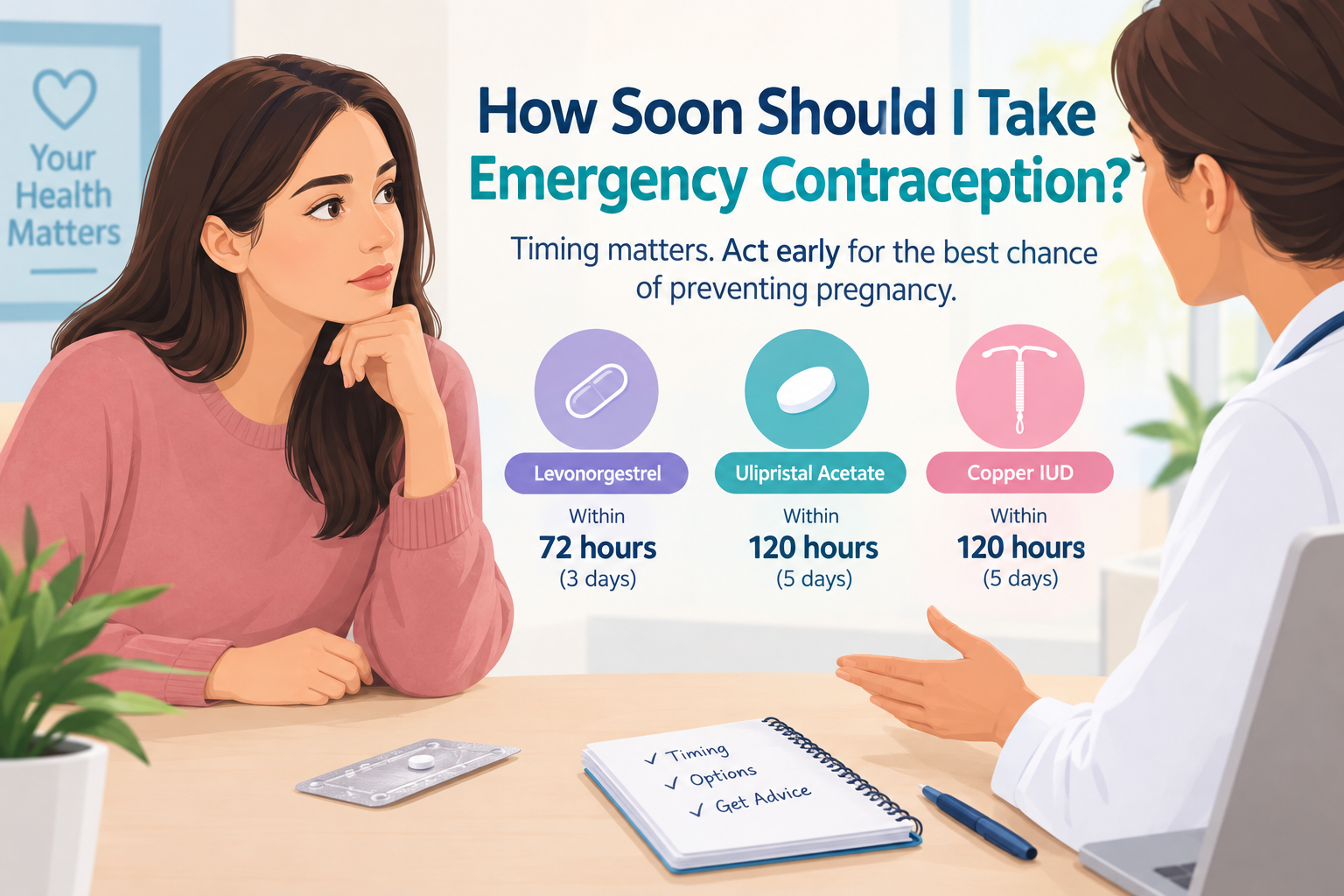
Emergency contraception is most effective when accessed promptly after unprotected sex, with different options available according to the time that has passed. Levonorgestrel, ulipristal acetate, and the copper intrauterine device each carry different time limits and effectiveness profiles. Understanding these timings, limits, and the factors that can affect suitability helps clarify the appropriate steps to take after contraceptive failure.
Emergency contraception is designed for situations where sex has happened without contraception or contraception has failed. Timing matters, and taking emergency contraception as soon as possible can improve the chance of preventing pregnancy.
The right option depends on how much time has passed, the type of emergency contraception available, and individual circumstances. Knowing the time limits can make it easier to act promptly rather than waiting until the last available window.
What Is The Best Timing To Take An Emergency Contraception Pill?
The emergency contraceptive pill has different time limits depending on the type. Levonorgestrel emergency contraception needs to be taken within 72 hours, or three days, after unprotected sex. Ulipristal acetate can be taken within 120 hours, or five days.
A copper intrauterine device, commonly called a copper coil, can also be used as emergency contraception. It can generally be fitted within five days of unprotected sex and is the most effective form of emergency contraception.
Does The Time Of Day Matter?
No specific time of day is required. The important factor is the number of hours that have passed since unprotected sex.
The phrase "morning-after pill" can sometimes give the impression that emergency contraception needs to be taken the morning after sex. It does not. The emergency pill can be taken during the day or at night, provided it is taken within the relevant time limit.
How Effective Is Emergency Contraception?
The effectiveness of emergency contraception depends partly on how soon it is used and which method is chosen. The emergency contraceptive pill is not guaranteed to prevent pregnancy, so prompt access is important.
The copper IUD is the most effective form of emergency contraception. It also has the advantage of providing ongoing contraception after it has been fitted.
Emergency contraception does not end an existing pregnancy and does not protect against sexually transmitted infections. Condoms remain important for reducing the risk of sexually transmitted infections during sex.
Understanding Morning-After Pill Timing
The term morning-after pill covers emergency contraceptive pills that can be used after unprotected sex. In the UK, the two main oral options have different time limits.
Emergency contraception | Time limit after unprotected sex |
Levonorgestrel emergency pill | Within 72 hours |
Ulipristal acetate emergency pill | Within 120 hours |
Copper IUD | Generally within 120 hours |
The Need For Emergency Contraception After Unprotected Sex
Emergency contraception may be needed after sex without contraception, a condom splitting or coming off, or contraception being used incorrectly.
It is useful to seek advice promptly rather than trying to calculate the risk alone. A pharmacist, GP, sexual health clinic or other appropriate healthcare professional can assess the situation and discuss available options.
Fylde Clinic provides a convenient option for those looking to get a free emergency contraception consultation, helping patients access emergency contraception through an appropriate clinical process.
Certain medicines can also affect the suitability or effectiveness of the emergency contraceptive pill. Medicines used for epilepsy, tuberculosis and HIV, along with some medicines and St John's wort, can require additional advice.
What If Several Days Have Passed?
Several days passing does not automatically mean that emergency contraception is no longer possible.
Levonorgestrel has a 72-hour limit, while ulipristal acetate can be used up to 120 hours after unprotected sex. A copper IUD can also be fitted within an appropriate five-day window.
If the 72-hour window has passed, it is important not to assume that every option has expired. Getting professional advice quickly can help identify the remaining choices.
What If There Has Been More Than One Episode?
The timing of each episode can affect the emergency contraception options available. Sharing accurate information about all recent episodes of unprotected sex helps a healthcare professional recommend an appropriate option.
Avoid relying on emergency contraception as a regular contraceptive method. Regular contraception can provide more consistent protection against pregnancy.
When To Take A Copper IUD As Emergency Contraception?
The best time to take emergency contraception is as soon as it is needed and available. There is no need to wait until the following morning. For the emergency contraceptive pill, the relevant deadline depends on the active ingredient. Levonorgestrel should be taken within 72 hours, while ulipristal acetate can be taken within 120 hours.
The copper IUD has a different process because it needs to be fitted by a trained healthcare professional. It can be used as emergency contraception within the appropriate five-day timeframe.
What Happens After Taking Emergency Contraception?
The next period may arrive earlier or later than expected after taking an emergency contraceptive pill. Some people may also experience temporary side effects such as nausea, headache, or tummy pain.
Emergency contraception does not provide ongoing protection for the rest of the menstrual cycle. Further unprotected sex can create another pregnancy risk, so suitable contraception should be used afterwards.
When Should a Pregnancy Test Be Taken?
A pregnancy test can provide reassurance if there is concern about pregnancy after emergency contraception. Testing may also be appropriate if the next period is late or unusual.
If there is uncertainty about pregnancy after emergency contraception, a pharmacist, GP, or sexual health professional can provide further advice.
Acting Within the Recommended Window
The emergency contraception time limit depends on the method used. This is why getting advice quickly is important, particularly if several hours or days have already passed.
The emergency pill has a maximum window of either three or five days, depending on the type. The copper IUD generally has a five-day window based on the timing of unprotected sex and, in some circumstances, the estimated timing of ovulation.
Conclusion
Emergency contraception is time-sensitive, so understanding emergency contraception timing and taking action promptly is important. Levonorgestrel can be used within 72 hours, ulipristal acetate within 120 hours, and a copper IUD can generally be fitted within five days. The sooner appropriate emergency contraception is accessed, the more useful the available options may be.
Need to order emergency contraception online? Fylde Clinic offers a fast, confidential way to access treatment through an appropriate clinical assessment.